Sample source
Browse the full sample on GitHub: raytrace_tutorial/05_shadow_miss
05 Shadow Miss Shader - Tutorial
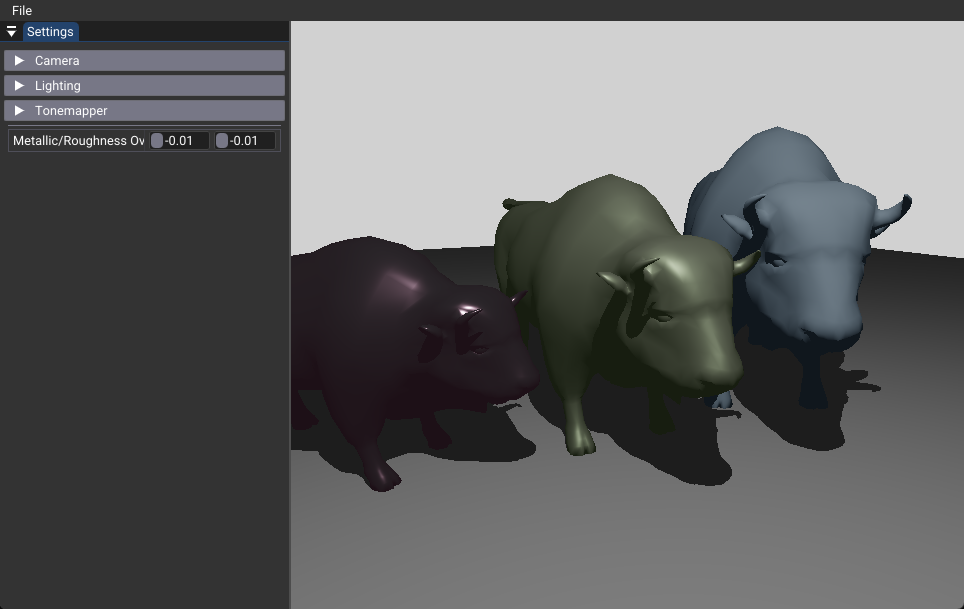
This tutorial demonstrates how to optimize shadow ray tracing performance by using a dedicated shadow miss shader with a minimal payload structure. Instead of reusing the main miss shader for shadow testing, we create a specialized miss shader that only performs the essential shadow occlusion test, resulting in significant performance improvements.
Key Changes from 02_basic.cpp
1. Shader Changes
Modified: shaders/rtshadowmiss.slang
- Added a new dedicated shadow miss shader (rmissShadowMain) specifically for shadow rays
- Introduced a minimal ShadowPayload structure containing only essential shadow testing data
- Modified shadow testing to use the dedicated miss shader group instead of the main miss shader
// Minimal payload for shadow rays - only what we need for shadow testing
struct ShadowPayload
{
  int depth;  // Only need to know if we hit something or not
};

[shader("miss")]
void rmissShadowMain(inout ShadowPayload payload)
{
  // Simple shadow miss shader - no complex lighting calculations
  payload.depth = MISS_DEPTH;
}
2. C++ Application Changes
Modified: 05_shadow_miss.cpp
- Added a new shader stage for the shadow miss shader in the ray tracing pipeline
- Created an additional shader group (group 2) for the shadow miss shader in the SBT
- Updated the pipeline creation to include the dedicated shadow miss shader
enum StageIndices
{
  eRaygen,
  eMiss,
  eMissShadow,  // <---- Dedicated shadow miss shader
  eClosestHit,
  eShaderGroupCount
};

// Shadow Miss shader group
group.type          = VK_RAY_TRACING_SHADER_GROUP_TYPE_GENERAL_KHR;
group.generalShader = eMissShadow;  // <---- Shadow miss shader group
shaderGroups.push_back(group);
3. Data Structure Changes
Modified: Shadow Testing Function
- Updated testShadow() function to use the dedicated shadow miss shader (group 1)
- Changed shadow ray tracing to use the minimal ShadowPayload instead of the full HitPayload
// Trace the shadow ray using the dedicated shadow miss shader (group 1)
TraceRay(topLevelAS, RAY_FLAG_ACCEPT_FIRST_HIT_AND_END_SEARCH | RAY_FLAG_SKIP_CLOSEST_HIT_SHADER, 0xff, 0, 0, 1,
         shadowRay, shadowPayload);
How It Works
The optimization works by separating shadow ray handling from primary ray handling:
- Primary rays use the main miss shader (
rmissMain) which handles complex sky rendering and lighting calculations - Shadow rays use the dedicated shadow miss shader (
rmissShadowMain) which only sets a simple flag indicating no occlusion occurred - Payload optimization reduces memory bandwidth by using a minimal payload structure for shadow rays
Benefits
- Reduced Memory Bandwidth: Shadow rays carry only essential data instead of full lighting information
- Faster Miss Shader Execution: Shadow miss shader avoids expensive sky and lighting calculations
- Better Cache Utilization: Smaller payload structures improve cache efficiency
- Scalable Performance: Benefits increase with the number of shadow rays in the scene
Technical Details
The tutorial uses four shader groups in the Shader Binding Table (SBT): - Group 0: Ray generation shader - Group 1: Main miss shader for primary rays (handles sky rendering) - Group 2: Shadow miss shader for shadow rays (minimal processing) - Group 3: Closest hit shader group
Shadow rays still use RAY_FLAG_SKIP_CLOSEST_HIT_SHADER to avoid unnecessary hit processing, but now benefit from a specialized miss shader that only performs the essential shadow occlusion test.
Scene Setup
The tutorial creates a complex scene with multiple Wuson character instances and a ground plane to demonstrate realistic shadow casting and the performance benefits of the dedicated shadow miss shader approach.