Sample source
Browse the full sample on GitHub: raytrace_tutorial/08_intersection
08 Intersection - Tutorial
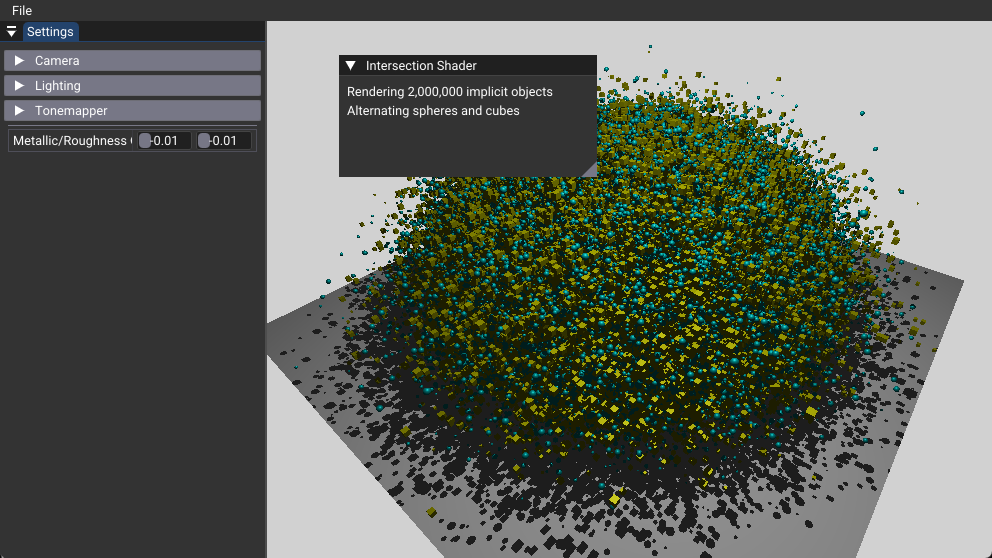
This tutorial demonstrates how to use intersection shaders to render implicit primitives (spheres and cubes) alongside traditional triangle geometry. It introduces the concept of procedural hit groups and custom ray-primitive intersection tests, enabling ray tracing of mathematically defined shapes without requiring explicit triangle meshes.
Key Changes from 02_basic.cpp
1. Shader Changes
Modified: shaderio.h
- Added new binding point eImplicit for implicit object data
- Introduced ImplicitObjectKind enum to distinguish between spheres and cubes
- Added Sphere and Aabb structures for implicit primitive data
New: Intersection Shader
- Created rintMain() function that performs custom ray-primitive intersection tests
- Implements both ray-sphere and ray-AABB intersection algorithms
- Uses ReportHit() to communicate intersection results to the ray tracing pipeline
[shader("intersection")]
void rintMain()
{
  float3 rayOrigin = WorldRayOrigin();
  float3 rayDirection = WorldRayDirection();
  Sphere sphere = allSpheres[PrimitiveIndex()];

  // Determine primitive type and perform intersection test
  int hitKind = PrimitiveIndex() % 2 == 0 ? eSphere : eCube;
  float tHit = (hitKind == eSphere) ? hitSphere(sphere, rayOrigin, rayDirection)
                                   : hitAabb(sphere, rayOrigin, rayDirection);

  if(tHit > 0)
  {
    BuiltInTriangleIntersectionAttributes attr;
    ReportHit(tHit, hitKind, attr);
  }
}
Modified: Closest Hit Shader
- Added rchitMain2() for implicit object shading
- Calculates analytical normals for spheres and cubes
- Handles different material properties based on primitive type
2. C++ Application Changes
Modified: 08_intersection.cpp
- Added member variables for implicit object storage and buffers
- Implemented createSpheres() function to generate 2M implicit primitives
- Created AABB-based acceleration structure using VK_GEOMETRY_TYPE_AABBS_KHR
Pipeline Changes:
- Added procedural hit group combining intersection and closest hit shaders
- Configured shader group type as VK_RAY_TRACING_SHADER_GROUP_TYPE_PROCEDURAL_HIT_GROUP_KHR
// Procedural hit group for implicit objects
group.type = VK_RAY_TRACING_SHADER_GROUP_TYPE_PROCEDURAL_HIT_GROUP_KHR;
group.closestHitShader = eClosestHit2;
group.intersectionShader = eIntersection;
3. Data Structure Changes
New Buffer Types:
- m_spheresBuffer: Storage buffer containing sphere data
- m_spheresAabbBuffer: AABB data for acceleration structure building
- m_spheresMatColorBuffer: Material properties for implicit objects
- m_spheresMatIndexBuffer: Material index mapping
Descriptor Binding:
- Added eImplicit binding point for implicit object data access
- Updated descriptor layout to include storage buffer for sphere data
How It Works
Intersection shaders extend ray tracing beyond triangle geometry by allowing custom ray-primitive intersection tests. Instead of relying on hardware triangle intersection, the intersection shader performs mathematical calculations to determine if a ray intersects with implicit primitives like spheres or boxes.
The process works as follows: 1. AABB Culling: The acceleration structure uses axis-aligned bounding boxes to quickly cull non-intersecting primitives 2. Custom Intersection: When a ray potentially intersects an AABB, the intersection shader performs the actual geometric test 3. Hit Reporting: If an intersection is found, the shader reports the hit distance and primitive type 4. Shading: The closest hit shader calculates lighting using analytical normals and material properties
Benefits
- Memory Efficiency: Implicit primitives require only mathematical parameters (center, radius) rather than full triangle meshes
- Scalability: Can render millions of simple shapes with minimal memory overhead
- Flexibility: Supports any mathematically definable primitive through custom intersection tests
- Performance: AABB-based acceleration structures provide efficient culling for implicit objects
Technical Details
Intersection Algorithms: - Ray-Sphere: Uses quadratic formula to solve intersection equation - Ray-AABB: Implements slab method for efficient box intersection testing
Normal Calculation: - Spheres: Normal = normalize(hitPoint - sphereCenter) - Cubes: Normal aligned to the major axis of the intersection face
Performance Considerations: - Intersection shaders add computational overhead compared to hardware triangle intersection - AABB culling is crucial for performance with large numbers of implicit objects - Memory bandwidth is reduced since only primitive parameters are stored, not full geometry
Usage Instructions
The tutorial automatically generates 2,000,000 implicit objects with: - Random positions following normal distribution - Varying radii between 0.05 and 0.2 units - Alternating materials (cyan and yellow) - Mixed sphere and cube primitives
The scene demonstrates the scalability of intersection shaders while maintaining interactive frame rates through efficient acceleration structure culling.