Sample source
Browse the full sample on GitHub: raytrace_tutorial/21_clusters
21 Clusters (CLAS) - Tutorial
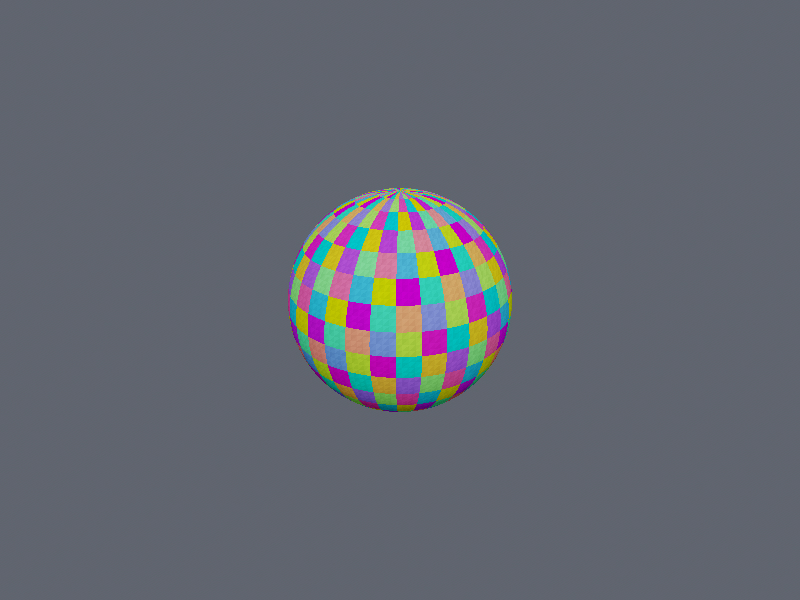
This chapter introduces Cluster Acceleration Structures (CLAS), exposed by the
VK_NV_cluster_acceleration_structure extension, and uses them to drive a simple
cluster-based level of detail (LOD). CLAS are the building block behind
mega-geometry and LOD-cluster ray tracing; here we strip the idea down to the
essentials so the mechanics are easy to follow.
Unlike the earlier chapters, this sample does not load a glTF scene. It generates a unit sphere procedurally at four levels of detail, splits each level into small triangle patches (the clusters), builds all of them into CLAS once, and then swaps the level the camera sees by refitting a single-instance top-level AS.
Key Takeaway: A CLAS is a small BVH over one cluster's triangles. You build the expensive triangle data once, then cheaply assemble a bottom-level AS from any subset of the already-built CLAS. That "build once, recompose cheaply" pattern is why CLAS exist, and it is what makes per-frame LOD and streaming affordable.
What the sample does
At startup:
- Build all clusters of all levels into CLAS
(
op = BUILD_TRIANGLE_CLUSTER) — one time — assigning each aclusterID. - Build one cluster bottom-level AS per level
(
op = BUILD_CLUSTERS_BOTTOM_LEVEL), each referencing that level's CLAS.
Every frame it picks a level from the camera distance (or a manual override in the UI), points a regular top-level AS at that level's cluster BLAS, and ray traces. On a hit, the closest-hit shader reads the per-hit cluster ID and colorizes the surface, so the cluster decomposition is directly visible.
Move closer and the level rises, so more, finer clusters appear (8 → 32 → 128 → 512 for the four levels here):
| Level 0 — 8 clusters | Level 1 — 32 clusters | Level 2 — 128 clusters | Level 3 — 512 clusters |
|---|---|---|---|
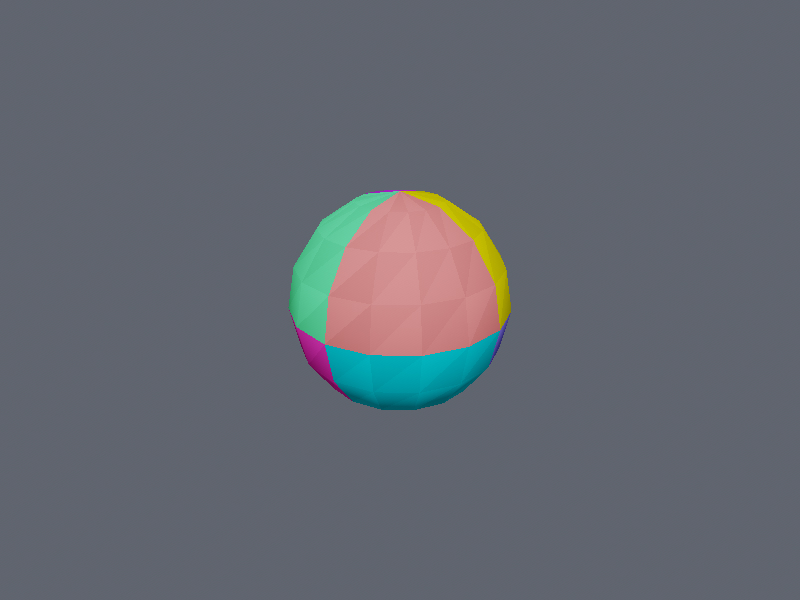 |
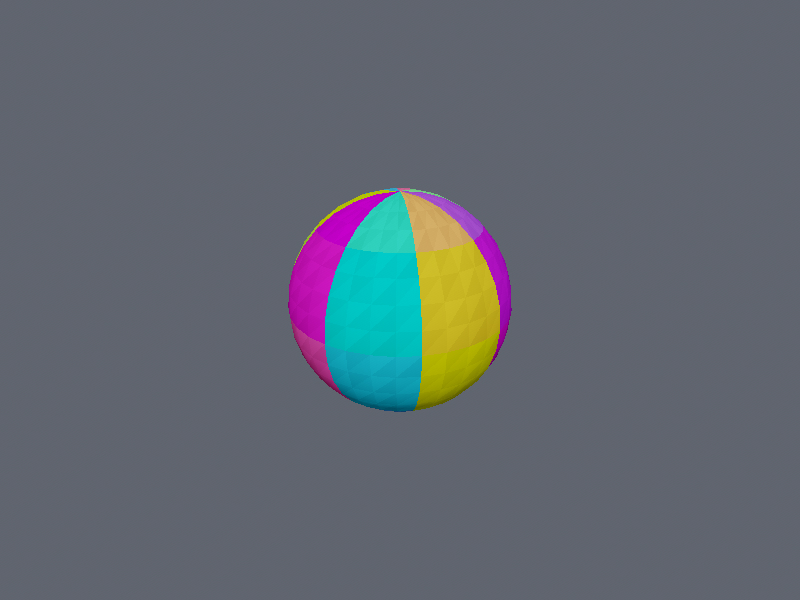 |
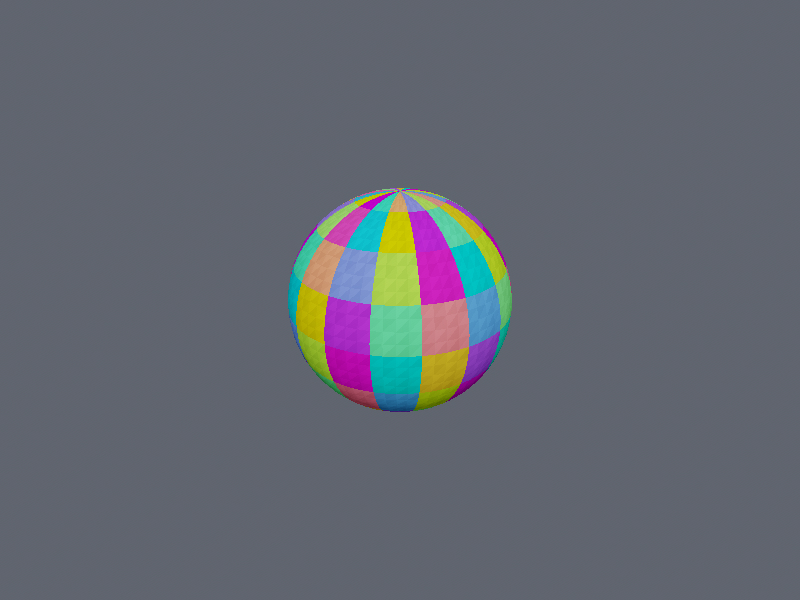 |
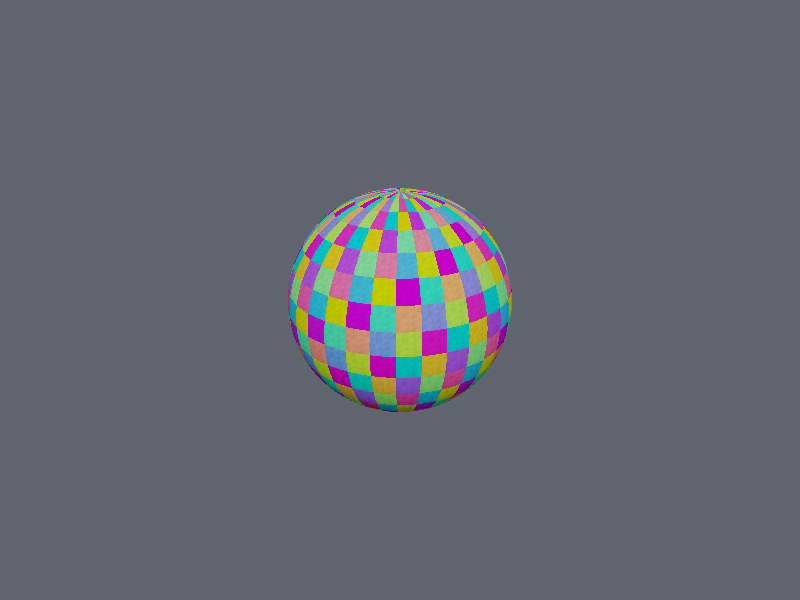 |
The idea: one extra level of indirection
Classic ray tracing traverses TLAS → BLAS → triangles. Clusters add one level in
between: a cluster BLAS whose leaves are references to CLAS, and each CLAS is itself a BVH
over a cluster's triangles.
(leaves = CLAS refs)"] --> kC["CLAS
(BVH over triangles)"] --> kTri[triangles] end
There are two acceleration structures below the TLAS, not one:
- A CLAS is a complete little BVH over the triangles of one cluster
(
BUILD_TRIANGLE_CLUSTER). This is where the triangle-level acceleration data lives. Each CLAS has its own device address. - A cluster BLAS is a real BLAS with its own storage and device address (the one the
TLAS instance references), but its leaves are references to CLAS, not triangles
(
BUILD_CLUSTERS_BOTTOM_LEVEL, input = a list of CLAS addresses).
The cluster BLAS is not "the CLAS concatenated together" — it is a separate, thin structure that indexes them (a table of contents that says "this object is made of CLAS #A, #B, #C…"). A TLAS instance can only reference a BLAS, so this BLAS is also the adapter that makes a bag of CLAS look like one object the TLAS can point at.
Why split it this way: CLAS are built once (the expensive triangle-BVH work), and the cluster BLAS is cheap to (re)build because it only gathers pointers. That is what makes per-frame LOD / streaming affordable — you re-assemble a BLAS from a chosen subset of the already-built CLAS without ever touching triangles. In classic RT, changing a BLAS means reprocessing all its triangles.
Decomposing the mesh into clusters
A cluster is just a small, self-contained chunk of a mesh. Here we take the sphere's
latitude-longitude grid and cut it into 4 × 4-cell patches; each patch becomes one
cluster with its own local vertices and 8-bit triangle indices.
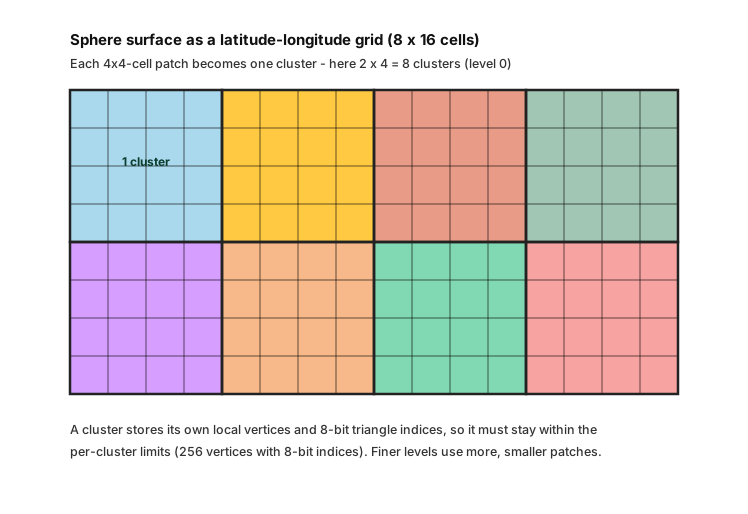
Because a cluster carries local, 8-bit indices, it must stay within the per-cluster limits
reported by VkPhysicalDeviceClusterAccelerationStructurePropertiesNV
(maxVerticesPerCluster, maxTrianglesPerCluster). The generator tracks the largest cluster it
produces and checks it against those limits at runtime; if a device reports smaller limits, the
sample disables the cluster path instead of building invalid CLAS.
Modified: 21_clusters.cpp — appendSphereLevel()
// Each 4x4-cell patch becomes one cluster with its own local vertices and 8-bit indices.
ClusterInfo cluster{
    .vertexByteOffset = uint32_t(m_vertices.size() * sizeof(glm::vec3)),
    .indexByteOffset  = uint32_t(m_indices.size()),
    .vertexCount      = uint32_t(localVerts.size()),
    .triangleCount    = uint32_t(localIndices.size() / 3),
};
m_clusters.push_back(cluster);
m_maxClusterVertices  = std::max(m_maxClusterVertices, cluster.vertexCount);
m_maxClusterTriangles = std::max(m_maxClusterTriangles, cluster.triangleCount);
All levels are concatenated into a single vertex buffer and a single 8-bit index buffer;
each ClusterInfo records where its slice begins.
Building the acceleration structures
Both builds are issued with the same command,
vkCmdBuildClusterAccelerationStructureIndirectNV, and both use the
IMPLICIT_DESTINATIONS op mode: the driver sub-allocates each output AS out of one storage
blob and writes the resulting device addresses into an array we supply. The CLAS addresses
produced by pass 1 feed straight into pass 2, entirely on the GPU.
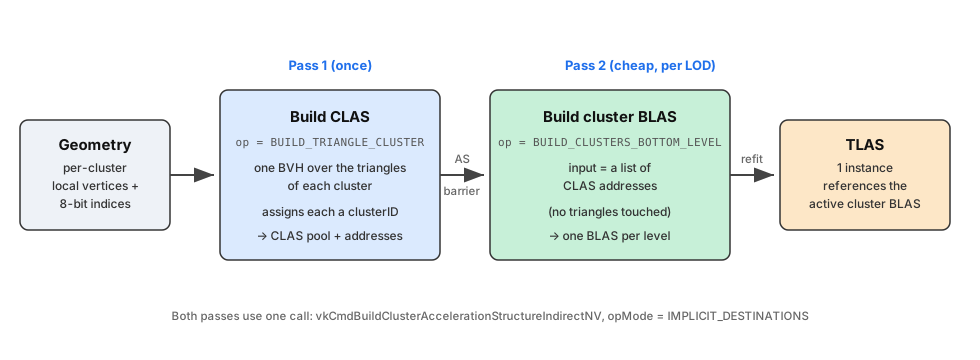
Pass 1 — building the CLAS
Each cluster gets one VkClusterAccelerationStructureBuildTriangleClusterInfoNV. The
load-bearing field is clusterID: this is the value the closest-hit shader reads back on a
hit.
Modified: 21_clusters.cpp — buildClusterAccelerationStructures()
VkClusterAccelerationStructureBuildTriangleClusterInfoNV info{};
info.clusterID          = i;  // <-- surfaced to the shader on a hit
info.triangleCount      = c.triangleCount;
info.vertexCount        = c.vertexCount;
info.indexType          = VK_CLUSTER_ACCELERATION_STRUCTURE_INDEX_FORMAT_8BIT_NV;
info.indexBufferStride  = 1;
info.vertexBufferStride = uint16_t(sizeof(glm::vec3));
info.baseGeometryIndexAndGeometryFlags.geometryFlags = VK_CLUSTER_ACCELERATION_STRUCTURE_GEOMETRY_OPAQUE_BIT_NV;
info.indexBuffer        = m_indexBuffer.address  + c.indexByteOffset;
info.vertexBuffer       = m_vertexBuffer.address + c.vertexByteOffset;
The build itself records into a command buffer; sizes come from
vkGetClusterAccelerationStructureBuildSizesNV:
VkClusterAccelerationStructureInputInfoNV clasInput{
    .maxAccelerationStructureCount = numClusters,
    .flags   = VK_BUILD_ACCELERATION_STRUCTURE_PREFER_FAST_TRACE_BIT_KHR,
    .opType  = VK_CLUSTER_ACCELERATION_STRUCTURE_OP_TYPE_BUILD_TRIANGLE_CLUSTER_NV,
    .opMode  = VK_CLUSTER_ACCELERATION_STRUCTURE_OP_MODE_IMPLICIT_DESTINATIONS_NV,
    .opInput = {.pTriangleClusters = &triangleInput}};
// ... fill clasCmd with dstImplicitData = m_clasBuffer, dstAddressesArray = m_clasAddressBuffer ...
vkCmdBuildClusterAccelerationStructureIndirectNV(cmd, &clasCmd);
Pass 2 — the cluster BLAS
The second build takes CLAS addresses, not vertices. Each level's cluster BLAS references a contiguous slice of the shared CLAS-address pool:
blasInfos[l].clusterReferencesCount  = m_lods[l].clusterCount;
blasInfos[l].clusterReferencesStride = sizeof(uint64_t);
blasInfos[l].clusterReferences       = m_clasAddressBuffer.address + m_lods[l].clasOffset * sizeof(uint64_t);
An acceleration-structure barrier separates the two builds — pass 2 reads what pass 1 wrote:
vkCmdBuildClusterAccelerationStructureIndirectNV(cmd, &clasCmd);   // pass 1: CLAS
nvvk::accelerationStructureBarrier(cmd, VK_ACCESS_ACCELERATION_STRUCTURE_WRITE_BIT_KHR,
                                        VK_ACCESS_ACCELERATION_STRUCTURE_READ_BIT_KHR);
vkCmdBuildClusterAccelerationStructureIndirectNV(cmd, &blasCmd);   // pass 2: cluster BLAS
Driving the level of detail
The CLAS for every level are built once into a shared pool, and each level's cluster BLAS references that level's slice of the pool. A single-instance TLAS is refit (updated in place, not rebuilt) to point at whichever level is active:
(8 clusters)"] L1["level 1 CLAS
(32 clusters)"] L2["level 2 CLAS
(128 clusters)"] L3["level 3 CLAS
(512 clusters)"] end B0["cluster BLAS L0"] --> L0 B1["cluster BLAS L1"] --> L1 B2["cluster BLAS L2"] --> L2 B3["cluster BLAS L3"] --> L3 TLAS["TLAS
(1 instance)"] -. refit to active level .-> B1
The TLAS is built once with ALLOW_UPDATE | PREFER_FAST_TRACE. Switching detail only
rewrites the single instance to reference a different BLAS address and updates the TLAS in
place — the instance count never changes, so a cheap refit is enough (no destroy/rebuild).
Modified: 21_clusters.cpp — selectLod() / setLevel()
int selectLod() const  // distance-based, or a manual UI override
{
  if(m_lodOverride >= 0) return std::min(m_lodOverride, kNumLevels - 1);
  const double d = m_cameraManip->getDistanceToCenter();
  if(d > 6.0) return 0;
  if(d > 4.0) return 1;
  if(d > 2.5) return 2;
  return 3;
}

void setLevel(int level)
{
  vkDeviceWaitIdle(m_app->getDevice());              // rare event: a full wait is fine here
  if(m_tlas.accel == VK_NULL_HANDLE) buildTlas(m_lods[level].blasAddress);  // first time
  else                              refitTlas(m_lods[level].blasAddress);   // afterwards
  m_currentLevel = level;
}
The
vkDeviceWaitIdleinsetLevelkeeps this minimal demo simple (LOD changes are rare and driven by the UI). A production renderer would double-buffer the instance data and refit on the frame's command buffer instead.
Can one BLAS mix CLAS from different levels?
Yes. The clusterReferences list can point at any CLAS from the shared pool, in any
mix — e.g. fine (level 3) CLAS for the front patches and coarse (level 0) CLAS for the back.
That is exactly how production per-cluster LOD works: each frame, per cluster, pick a detail
level by screen-space error, collect those CLAS addresses, and rebuild the (cheap) cluster
BLAS from the mixed list (the CLAS never change). This sample only uses one level at a time
to stay minimal, but the mechanism is identical.
The catch — cracks. Putting a fine cluster next to a coarse one leaves mismatched edges
(T-junctions) → visible holes. In this sample mixing levels would crack, because each
level is an independent UV-sphere tessellation with no shared boundary vertices. Production
systems (Nanite; the vk_lod_clusters sample via meshoptimizer) avoid this by building a
boundary-locked cluster LOD hierarchy (DAG): shared group edges are preserved across
levels and whole groups are switched together, so adjacent selected clusters always share
matching edges. That boundary-locked simplification is the genuinely hard part of a
cluster-LOD system, and it is what this minimal sample deliberately omits.
Reading the cluster ID in the shader
Two things are required to read the per-hit cluster ID:
- The ray tracing pipeline must opt in, or the built-in is invalid:
Modified: 21_clusters.cpp — createRayTracingPipeline()
VkRayTracingPipelineClusterAccelerationStructureCreateInfoNV clusterPipeInfo{
    .sType = VK_STRUCTURE_TYPE_RAY_TRACING_PIPELINE_CLUSTER_ACCELERATION_STRUCTURE_CREATE_INFO_NV,
    .allowClusterAccelerationStructure = VK_TRUE};
rtPipelineInfo.pNext = &clusterPipeInfo;   // attach to VkRayTracingPipelineCreateInfoKHR
The closest-hit shader hashes that ID to a color (so each cluster is visibly distinct) and
adds a subtle per-triangle brightness from PrimitiveIndex (the triangle index within its
cluster), which reveals the individual triangles inside each cluster. Because the mesh is a
unit sphere centered at the origin, the surface normal is simply the normalized hit position
— no vertex/normal buffers are needed:
int    clusterID = GetClusterID();
float3 normal    = normalize(WorldRayOrigin() + RayTCurrent() * WorldRayDirection());
float3 base      = (pushConst.colorByCluster != 0) ? clusterColor(uint(clusterID)) : float3(0.8);
float  triVar    = 0.8 + 0.2 * frac(float(PrimitiveIndex()) * 0.6180339887);
float  diffuse   = max(dot(normal, normalize(pushConst.lightDir)), 0.0);
payload.color    = base * triVar * (0.15 + 0.85 * diffuse);
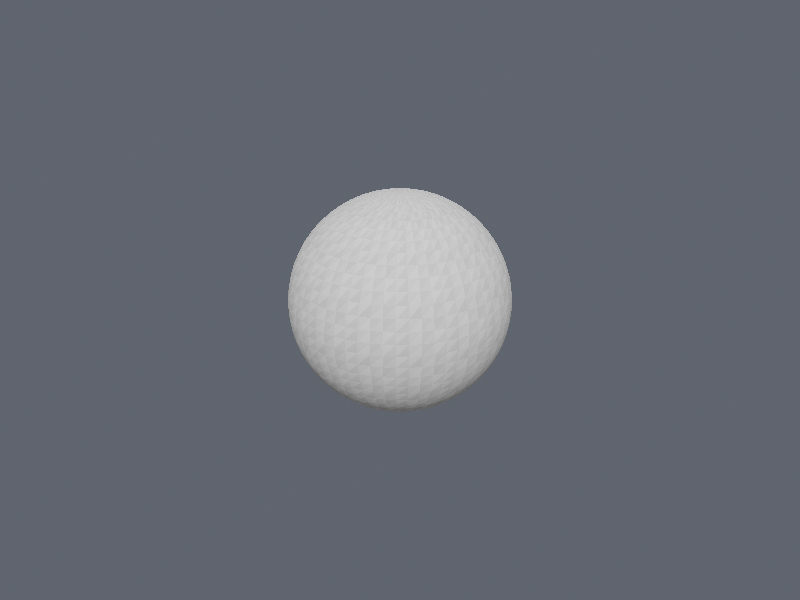
Toggle Color by cluster off to compare with plain shading:
| Color by cluster (level 2) | Plain shading (level 2) |
|---|---|
|
 |
Key points
- CLAS by itself is not LOD — it is the mechanism. The LOD here (select a level, swap
which cluster BLAS the TLAS references) is a thin layer on top. The production-scale
version of this idea is the
vk_lod_clusterssample (streaming + screen-space error + per-frame BLAS rebuild). - Both CLAS and cluster-BLAS builds use
IMPLICIT_DESTINATIONS: the driver sub-allocates each output AS from one storage blob and writes the resulting device addresses into an array we provide, so the CLAS addresses feed straight into the BLAS build. - Per-cluster vertices are local
vec3lists with 8-bit indices, so each cluster stays within the 256-vertex limit. - The pipeline must be created with
VkRayTracingPipelineClusterAccelerationStructureCreateInfoNV{ allowClusterAccelerationStructure = VK_TRUE }for the cluster-ID built-in to be valid.
Technical details
- Extension / feature:
VK_NV_cluster_acceleration_structure(requested at spec version 2), with the usual RT stack (VK_KHR_acceleration_structure,VK_KHR_ray_tracing_pipeline,VK_KHR_deferred_host_operations). The device is queried forclusterAccelerationStructuresupport; if absent, the sample still runs and reports it in the UI. - Alignments come from
VkPhysicalDeviceClusterAccelerationStructurePropertiesNV(clusterScratchByteAlignment,clusterByteAlignment,clusterBottomLevelByteAlignment) and are passed to the corresponding buffer allocations. - Framework fit: this chapter derives from
RtBaselike the others, but overridescreateScene,createBottomLevelAS,createTopLevelAS,createRayTracingPipeline, andraytraceSceneto replace the glTF/triangle-BLAS path with the CLAS path. The G-buffer, tonemapper, camera, and headless screenshot support are all reused unchanged.
Usage instructions
Run interactively and orbit the sphere: as the camera distance changes, the LOD (and the number of colored clusters) changes with it. In the Settings → Cluster Acceleration Structures panel:
- LOD selection —
Auto(distance-based) or forceLevel 0..3. - Color by cluster — toggle cluster coloring vs. plain shading.
- Light direction — orbit the diffuse light.
Command line (also used to generate the figures in this page):
--lod <n>forces a LOD level (-1= automatic).--colorByCluster <0|1>toggles cluster coloring.--headlessrenders one frame and writes a screenshot next to the executable.
Summary
CLAS introduce a single extra level below the TLAS: TLAS → cluster BLAS → CLAS →
triangles. You build the CLAS (the expensive triangle work) once, then assemble cheap
cluster BLAS from any subset of that pool. This chapter uses the simplest possible policy —
one level at a time, selected by camera distance, applied by refitting a one-instance TLAS —
to show the API mechanics end to end: the two build passes, IMPLICIT_DESTINATIONS, the
pipeline opt-in, and reading ClusterIDNV in the hit shader.
Next steps
- Explore the production-scale version — streaming, screen-space error, crack-free
boundary-locked LOD, and per-frame BLAS rebuilds — in the
vk_lod_clusterssample. - Try mixing CLAS from different levels in a single cluster BLAS and observe the cracks this minimal (non-boundary-locked) mesh produces.